This is default featured slide 1 title

Go to Blogger edit html and find these sentences.Now replace these sentences with your own descriptions.

This is default featured slide 2 title

Go to Blogger edit html and find these sentences.Now replace these sentences with your own descriptions.

This is default featured slide 3 title

Go to Blogger edit html and find these sentences.Now replace these sentences with your own descriptions.

This is default featured slide 4 title

Go to Blogger edit html and find these sentences.Now replace these sentences with your own descriptions.

This is default featured slide 5 title

Go to Blogger edit html and find these sentences.Now replace these sentences with your own descriptions.

Sunday, 3 July 2016

Google Chrome

Google’s Chrome browser has a new ‘Cast’ option, mirrors to Hangouts

Google Cast, the underlying technology behind Chrome cast, is being baked directly into Chrome, and can be used for Hangouts.

Chrome

The Chrome browser will have a new ‘Cast’ feature in the drop-down menu in Chrome 51, which is currently in beta.
As you can with the extension, Cast simply lets you cast your browser tab onto a TV or other Cast-enabled monitor. While the extension may no longer be needed, it’ll continue to work — and may be a more streamlined option if you cast often.
Interestingly, Google has also offloaded things like streaming rate and screen resolution to boilerplate functions. Instead of manicuring a good stream, you’ll soon just be streaming while Google Cast does the heavy lifting.
Cast will also be found in Chrome OS.


Hangouts

Google’s chat service is also getting the ability to receive Google Casts.
A beta feature first spotted last May, Cast to Hangouts now seems to be rolling out as a stable release. In the comments section of an Android Police article noting the feature, one user notes it also peeks into your calendar to find scheduled hangouts:
I have this working (though buggy) in Chrome OS v52. My workplace uses Hangouts for our meetings. If I choose the Cast option in the menu it finds meetings in my calendar and lets me share my tab or desktop to the hangout. It’s similar to screen sharing in a Hangout but there’s no audio transmitted. One use case is if you’re in a room set up with a Chrome box for Meetings and want to share your screen with everyone, without having to join the Hangout.
The support page for casting to Hangouts also lists ‘cloud services’ as options for casting, though doesn’t list any specifically. As casting seems to be best suited for video chats in Hangouts, it seems Google’s new Duo app could also see screen casts, but we’re betting Google is just laying the groundwork for any service that may use it down the line.
Chrome 51 is the stable release, but not all users are seeing the new Cast option in the drop-down menu. If you don’t find Cast as an option, give it time — Google tends to roll things out incrementally, stable or not.
Hangouts is also hit-and-miss on availability, but listed as an option for Chrome 52.

Monday, 13 June 2016

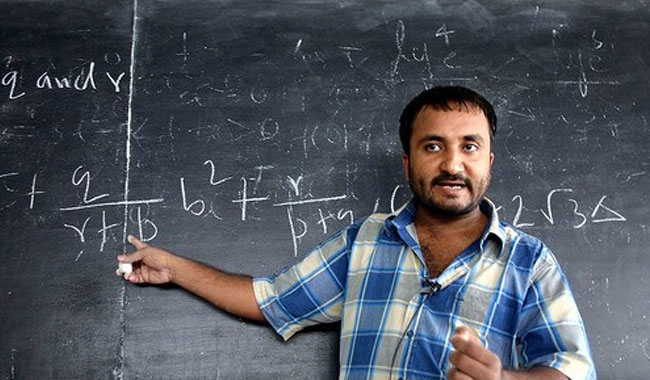
SUPER 30


Super thirty is associate degree Indian programme that started in Patna, Bihar, India beneath the banner of 'Ramanujan college of Mathematics', by Anand Kumar. Established in 2002, the program selects thirty meritable and gifted candidates annually from economically backward sections of society and trains them for the IIT-JEE, the doorway examination for Indian Institute of Technology. Time Magazine has elect man of science Anand Kumar's college - Super thirty - within the list of better of Asia 2010.,  Super thirty received praise from u.  s. President Barack Obama's special envoy Rashad Hussain, World Health Organization termed it the “best” institute within the country.  Newsweek Magazine has taken note of the initiative of man of science Anand Kumar’s Super thirty and enclosed his college within the list of 4 most innovative faculties within the world.  Anand Kumar has been awarded the Maulana Abul Kalam Azad Shiksha Puraskar, the very best award by the govt. of state in Gregorian calendar month 2010.

In 2002, Anand Kumar came up with the thought of Super thirty, wherein, he would choose thirty proficient students from economically impoverished sections World Health Organization couldn't afford IIT coaching job, through word of mouth and hone their skills and prepare them to crack the IIT-JEE. Anand Kumar's Mother, Jayanti Hindu deity, volunteered to cook for the scholars whereas Anand taught them, and additionally provided study materials and lodging for a year. In the 1st year of the coaching job, eighteen of the thirty students created it to IIT. the subsequent year saw several applications from students for the second batch of Super thirty, a written communication was conducted and thirty students were chosen. within the year 2004, twenty two out of thirty students qualified for IIT JEE and Super thirty got even a lot of applications from hopefuls. This was followed by a cutthroat attack on Anand in Nov that he at large and a few a lot of tries to abort the Super thirty Center. The authorities additionally provided security to him following the attacks and from the 2005 batch, twenty six out of thirty students created it to IIT. throughout 2006, IIT modified the examination pattern despite that then twenty eight out of the Super thirty students had cleared the IIT JEE, in appreciation of their efforts, Bihar Chief Minister Nitish Kumar felicitated the scholars with a money prize of Rupees fifty,000 each. the subsequent year twenty eight a lot of students achieved the IIT dream and at last in 2008, all of the Super thirty cleared the IIT JEE. Anand's former students additionally joined as lecturers for the Super thirty and within the year 2009, all thirty students once more managed to clear the IIT JEE.

Anand Kumar  is AN Indian scientist and a journalist for numerous national and international mathematical journals and magazines. he's best noted for his Super thirty programme, that he started in Patna, province in 2002, and that coaches economically backward students for IIT-JEE, the doorway examination for the Indian Institutes of Technology (IITs). By 2015, 333 out of the 390 had created it to IITs and Discovery Channel showcased his add a documentary.

He has been invited by the celebrated Massachusetts Institute of Technology (MIT) and university to talk on his globally acclaimed effort to mentor students from the deprived sections for admission to IIT.

Sunday, 5 June 2016

QUTUB MINAR


Qutub Minar in metropolis is world heritage website. The tall tower was made in 1192 by Qutab-ud-din Aibak, and later completed by his successor Iltutmish. The soaring cone-shaped tower is associate exquisite example of Indo-Islamic Afghan design.

Qutub Minar Height : 72.5 meteres or 237.8 feet

Steps in minar : 379 steps

Year designed : 1192

Address : Aurobindo Marg, Mehrauli, New Delhi

Built by :Qutab-ud-din Aibak

There are proof that Qutubminar was designed a lot of before by Hindu emperors. Later Kuttubuddin has replaced the writing on stones. Qutub Minar could be a World Heritage site and has survived the ravages of your time imposingly. The Minar of metropolis is enclosed by a lush inexperienced garden, that is a perfect leisurely place for guests. Qutab Minar is that the favorite destination of tourists. it's India's most visited monument attracting around three.9 million guests per annum. Qutub minar, metropolis every of the five storeys and tower of Qutub Minar has distinctive styles.It was hit by lightening few times and was broken. the next rulers repaired it. therefore it's standing mightily because it was before until date.

Qutab Minar could be a nice masterpiece of Mughal design. the bottom of the Qutub Minar measures fourteen.32 meters and therefore the high of the structure measures two.75 meters. The bird eye's read of metropolis town from the highest is superb. the bottom of 1st story has alternate angular and circular flutings, the other is spherical. The third story of the Qutub Minar has angular flutings. The balconies sticking out heighten the wonder of the Minar. The tower is therefore high that around 379 steps square measure required to be climbed to succeed in the highest. Another taller tower adjacent to Qutub Minar is known as Alai Minar that is somewhat tipped in one direction. The verses from the holy Qur'an square measure graven on arenaceous rock walls of Qutub Minar. This monument serves the aim of job folks for prayer within the Quwwat-ul-Islam masjid. this can be a tower of ending, a monument that signify the would possibly of Islam, or a tower for keeping a check for defense.

There square measure claims and proof that Qutubminar was engineered abundant before by Hindu emperors. Later Kuttubuddin has replaced the writing on stones. The stones has hindu God photos on one aspect and arabic writing on alternative aspect. Stones dislodged from the Minar have Hindu pictures on one aspect with Arabic writing on the opposite. Those stones square measure currently in repository. These stone represent that invaders wont to take away the stone- dressing of Hindu buildings, flip the stones within resolute hide the image facial and inscribe Arabic writing on the new frontage. The construction of Qutub Minar was commissioned by Qutub-ud-Din Aibak, the founding father of the metropolis country in 1199 AD. The minar was designed on the ruins of the Lal Kot, the Red bastion within the town of Dhillika.  It and also the complicated around it used the ruins of twenty seven Hindu and faith temples purposefully destroyed within the monotheism incursions. Aibak's successor Iltutmish intercalary 3 additional storeys to finish the tower.

It has not been established with certainty whether or not Qutub Minar has been named once Qutubu l-Din Aibak, the emperor UN agency commissioned its construction or Qutubuddin Bakhtiar kaki, the famed Sufi saint. The culture of tower design was established in Bharat before the arrival of the Turks. However, there's no proof on record to substantiate that the Qutub Minar was impressed or influenced by earlier Hindu towers. varied inscriptions in Parso-Arabic and Devanagari characters in numerous sections of the Qutub Minar reveal the history of its construction. in keeping with the inscriptions on its surface it absolutely was repaired by Firoz crowned head Tughlaq (1351–89) and Sikandar Lodi (1489–1517). The Quwwat-ul-Islam house of God, set to the north of Qutub Minar, was designed by Qutubu l-Din Aibak in 1192. it's one amongst the earliest living house of God within the Indian landmass. Later, associate arched screen was erected and also the house of God was enlarged by Iltutmish (1210–35) and Ala-ud-din Khilji.

The upmost floor was broken by lightning in 1368 A.D. and was remodeled by Firoz crowned head Tughlaq. Firoz crowned head Tughlaq designed 2 floors one amongst which might be distinguished simply because it was designed of white marble. In 1505, associate earthquake broken Qutub Minar and also the harm was repaired by Sikander Lodi. On one August 1903, a serious earthquake once more caused serious harm to Qutub Minar. Major Henry Martyn Robert Smith of country Indian Army restored the tower in 1928 and put in a cupola to the highest of Qutub Minar. The cupola was taken down in 1848, below directions from The Viscount Hardinge, then governor of Bharat and was put in to the east of Qutab Minar, wherever it rests currently.

Friday, 3 June 2016

Red Fort

The Red Fort was the residence of the Mughal emperor for nearly two hundred years, until 1857. it's placed within the centre of urban center and homes variety of museums. additionally to accommodating the emperors and their households, it had been the ceremonial and political centre of Mughal government and therefore the setting for events critically impacting the region.

Constructed in 1648 by the fifth Mughal Emperor Emperor because the palace of his fortified capital Shahjahanabad,  the Red Fort is known as for its huge introduction walls of red arenaceous rock and is adjacent to the older Salimgarh Fort, engineered by Islam monarch Suri in 1546. The imperial residences contains a row of pavilions, connected by a water channel called the Stream of Paradise (Nahr-i-Behisht). The fort advanced is taken into account to represent the celestial point of Mughal power beneath Emperor and though the palace was planned consistent with monotheism prototypes, every collapsible shelter contains fine arts parts typical of Mughal buildings that mirror a fusion of Timurid and Persian traditions. The Red Fort’s innovative art form, together with its garden style, influenced later buildings and gardens in urban center, Rajasthan, Punjab, Kashmir, Braj, Rohilkhand et al..  With the Salimgarh Fort, it had been selected a United Nations agency World Heritage web site in 2007 as a part of the Red Fort advanced.

On national holiday (15 August), the Prime Minister of INDIA hoists the 'tricolor' ensign at the most gate of the fort and delivers a nationally-broadcast speech from its ramparts.

 Emperor Emperor commissioned construction of the Red Fort in 1638, once he determined to shift his capital from city to city. Originally red and white, the Shah's favorite colors,  its style is attributable to designer Ustad Ahmad Lahauri, World Health Organization conjointly made the mausoleum.  The fort lies on the Yamuna watercourse, that fed the moats close most of the walls. Construction began within the sacred month of Muharram, on thirteen might 1638. supervised by Emperor, it absolutely was completed in 1648. not like alternative Mughal forts, the Red Fort's boundary walls ar asymmetrical to contain the older Salimgarh Fort. The fortress-palace was a center of attention of the medieval town of Shahjahanabad, that is current metropolis. Its coming up with and aesthetics represent the celestial point of Mughal ability prevailing throughout monarch Jahan's reign. His successor Aurangzeb more the Pearl house of God to the emperor's personal quarters, constructing barbicans ahead of the 2 main gates to form the doorway to the palace a lot of circuitous.

The administrative and monetary structure of the Mughal sept declined once Aurangzeb, and therefore the eighteenth century saw a degeneration of the palace. once Jahandar monarch took over the Red Fort in 1712, it had been while not Associate in Nursing emperor for thirty years. inside a year of starting his rule, monarch was dead and replaced by Farrukhsiyar. to boost cash, the silver ceiling of the Rang Mahal was replaced by copper throughout this era. Muhammad monarch, called 'Rangila' (the Colourful) for his interest in art, took over the Red Fort in 1719.  In 1739, Persian emperor Nadir monarch simply defeated the Mughal army, plundering the Red Fort as well as the Peacock Throne. Nadir monarch came back to Persia once 3 months, exploit a destroyed town and a weakened Mughal empire to Muhammad monarch. the inner weakness of the Mughal empire created the Mughals titular heads of city, and a 1752 pact created the Marathas protectors of the throne at city.  The 1758 Mahratta conquest of Lahore and Peshawar[16] placed them in conflict with Ahmad monarch Durrani. In 1760, the Marathas removed and melted  the silver ceiling of the Diwan-i-Khas to boost funds for the defence of city from the armies of Ahmed monarch Durrani.  In 1761, once the Marathas lost the third battle of pitched battle, city was raided by Ahmed monarch Durrani. 10 years later, monarch Alam ascended the throne in city with Mahratta support.  In 1783 the Sikh Misl Karorisinghia, semiconductor diode by Baghel Singh Dhaliwal, conquered city and therefore the Red Fort. The Sikhs in agreement to revive monarch Alam as emperor and retreat from the fort if the Mughals would build and shield seven Gurudwaras in city for the Sikh gurus.

During the Second Anglo-Maratha War in 1803, forces of British East Indies Company defeated Indian forces within the Battle of Delhi; this all over Indian rule of the town and their management of the Red Fort. once the battle, a people took over the administration of Mughal territories and put in a Resident at the Red Fort.  The last Mughal emperor to occupy the fort, Bahadur monarch II, became a logo of the 1857 rebellion against a people within which the residents of Shahjahanbad participated.

Despite its position because the seat of Mughal power and its defensive capabilities, the Red Fort wasn't defended throughout the 1857 insurrection against a people. once the rebellion failing, Bahadur monarch II left the fort on seventeen Sep and was appreciated by British forces. He came back to Red Fort as a unfortunate person of a people, was tried in 1858 and exiled to Rangoon on seven October of that year.  With the top of Mughal reign, a people sanctioned the systematic plunder of valuables from the fort's palaces. All piece of furniture was removed or destroyed; the hareem residences, servants' quarters and gardens were destroyed, and a line of stone barracks designed. solely the marble buildings on the side at the imperial enclosure free complete destruction, however were plundered and broken. whereas the defensive walls and towers were comparatively unscathed, quite common fraction of the inner structures were destroyed by a people. Lord Curzon, Viceroy of Asian nation from 1899–1905, ordered repairs to the fort as well as reconstruction of the walls and therefore the restoration of the gardens complete with a watering system.

Most of the jewels and artworks of the Red Fort were plundered and taken throughout Nadir Shah's invasion of 1747 and once more once the failing Indian Rebellion of 1857 against a people colonialists. They were eventually oversubscribed to non-public collectors or a people deposit, British Library and therefore the Victoria and Albert Francis Charles Augustus Emmanuel deposit. as an example, the Koh-i-Noor diamond, the jade wine cup of Shah Jahan and therefore the crown of Bahadur monarch II square measure all presently set in London. varied requests for restitution have to this point been rejected by a people government.

1911 saw the visit of a people king and queen for the urban center room. In preparation of the visit, some buildings were repaired. The Red Fort archaeologic deposit was conjointly affected from the drum house to the Mumtaz Mahal.

The INA trials, conjointly called the Red Fort Trials, discuss with the courts-martial of variety of officers of the Indian National Army. the primary was command between Nov and Gregorian calendar month 1945 at the Red Fort.


Red Fort in urban center on 1987 country item, dedicated to the competition of the country in Asian nation On fifteen August 1947, the primary Prime Minister of Asian nation statesman raised the Indian allegory on top of the city Gate. On every consequent Fourth of July, the prime minister has raised the flag and given a speech that's broadcast across the nation.

After Indian Independence the location full-fledged few changes, and therefore the Red Fort continued  to be used as a military military quarters. a major a part of the fort remained beneath Indian Army management till twenty two Gregorian calendar month 2003, once it absolutely was given to the archaeologic Survey of Asian nation for restoration. In 2009 the excellent Conservation and Management set up (CCMP), ready by the archaeologic Survey of Asian nation beneath Supreme Court directions to revitalize the fort, was declared.


Tuesday, 31 May 2016

TAJ MAHAL

TAJ MAHAL

The Taj Mahal  is AN ivory-white marble sepulture on the south bank of the Yamuna watercourse within the Indian town of urban center. it had been commissioned in 1632 by the Mughal emperor, Shah Jahan (reigned 1628–1658), to accommodate the grave of his favorite woman, Mumtaz Mahal. The grave is that the centrepiece of a 42-acre complicated, which has a house of God and a guest house, and is ready in formal gardens finite on 3 sides by a crenellated wall.

Construction of the sepulture was primarily completed in 1643 however work continuing on different phases of the project for one more ten years. The Taj Mahal complicated is believed to own been completed in its entireness in 1653 at a value calculable at the time to be around thirty two million rupees, that in 2015 would be roughly fifty two.8 billion rupees (US$827 million). the development project utilized some twenty,000 artisans beneath the steering of a board of creators LED by the court architect to the emperor, Ustad Ahmad Lahauri.

The Taj Mahal was selected as a UN agency World Heritage web site in 1983 for being "the jewel of Muslim art in Bharat and one in every of the universally loved masterpieces of the world's heritage". delineate by Nobel Laureate Rabindranath Tagore as "the tear-drop on the cheek of time", it's regarded by several because the best example of Mughal design and a logo of India's wealthy history. The Taj Mahal attracts 7–8 million guests a year. In 2007, it had been declared a winner of the New7Wonders of the planet (2000–2007) initiative.

The spot is that the central focus of the whole complicated of the mausoleum. it's an oversized, white marble structure standing on a sq. footstall ANd consists of a symmetrical building with an iwan (an arch-shaped doorway) flat-topped by an oversized dome and ornament. Like most Mughal tombs, the fundamental components area unit Persian in origin.

The base structure may be a massive multi-chambered cube with chamfered corners forming AN unequal eight-sided structure that's roughly fifty five metres (180 ft) on every of the four long sides. facet|all sides|both sides|either side} of the iwan is framed with a large pishtaq or rounded entrance with 2 equally formed arched balconies stacked on either side. This motif of stacked pishtaqs is replicated on the chamfered corner areas, creating the look fully symmetrical on all sides of the building. Four minarets frame the spot, one at every corner of the footstall facing the chamfered corners. the most chamber homes the false sarcophagi of Mumtaz Mahal and Shah of Iran Jahan; the particular graves area unit at a lower level.

The interior chamber of the Taj Mahal reaches so much on the far side ancient ornamental parts. The inlay work isn't pietra meninx, however a lapidary of precious and valuable gemstones. The inner chamber is associate polygon with the planning letting entry from every face, though solely the door facing the garden to the south is employed. the inside walls square measure concerning twenty five metres (82 ft) high and square measure topped  by a "false" interior dome embellished with a sun motif. Eight pishtaq arches outline the house at ground level and, like the outside, every lower pishtaq is topped by a second pishtaq concerning midway up the wall. The four central higher arches type balconies or viewing areas, and every balcony's exterior window has associate convoluted screen or jali cut from marble. additionally to the sunshine from the balcony screens, light-weight enters through roof openings lined by chattris at the corners. The polygon marble screen or jali bordering the cenotaphs is created from eight marble panels inscribed through with convoluted pierce work. The remaining surfaces square measure decorated in delicate detail with semi-precious stones forming twining vines, fruits and flowers. every chamber wall is extremely embellished with dado bas-relief, convoluted lapidary inlay and refined handwriting panels that mirror, in miniature detail, the planning parts seen throughout the outside of the advanced.

The Taj Mahal complicated is deckle-edged on 3 facets by crenellated red arenaceous rock walls; the side facing the stream is open. Outside the walls ar many extra mausoleums, as well as those of Shah of Iran Jahan's alternative wives, and a bigger spot for Mumtaz's favorite servant.

The main entrance (darwaza) could be a monumental structure engineered primarily of marble, and paying homage to the Mughal design of earlier emperors. Its archways mirror the form of the tomb's archways, and its pishtaq arches incorporate the script that decorates the spot. The domed ceilings and walls have elaborate geometric styles like those found within the alternative arenaceous rock buildings within the complicated.

At the way finish of the complicated ar 2 grand red arenaceous rock buildings that mirror one another, and face the perimeters of the spot. The backs of the buildings parallel the western and jap walls. The western building could be a musjid and therefore the alternative is that the jawab (answer), thought to own been made for beaux arts balance though it's going to are used as a house. Distinctions between the 2 buildings embody the jawab's lack of a mihrab (a niche during a mosque's wall facing Mecca), and its floors of geometric style whereas the ground of the musjid is arranged  with outlines of 569 prayer rugs in black marble. The mosque's basic style of an extended hall head by 3 domes is analogous to others engineered by Emperor, significantly the Masjid-i Jahān-Numā, or Jama mosque, Delhi. The Mughal mosques of this era divide the sanctuary hall into 3 areas comprising a main sanctuary and slightly smaller sanctuaries on either facet. At the Taj Mahal, every sanctuary opens onto AN expansive vaulting dome. The far buildings were completed in 1643.


Monday, 23 May 2016

Ashoka THE GREAT

ASHOKA THE GREAT


Ashoka  was an Indian emperor of the Maurya kinsfolk United Nations agency dominated nearly all of the Indian landmass from c. 268 to 232 BCE. One of India's greatest emperors, Ashoka reigned over a realm that stretched from the Hindu Kush mountains in Afghanistan to the fashionable state of Bangla Desh within the east. It covered the entire Indian landmass except elements of contemporary Tamil Nadu and Kerala. The empire's capital was Pataliputra (in Magadha, present-day Bihar), with provincial capitals at Taxila and Ujjain.

In about 260 BCE, Ashoka waged a bitterly destructive war against the state of Kalinga (modern Odisha).  He conquered Kalinga, which none of his ancestors had done.  He embraced Buddhism after witnessing the mass deaths of the Kalinga War, which he himself had waged out of a need for conquest. "Ashoka reflected on the war in Kalinga, which reportedly had resulted in additional than one hundred,000 deaths and 150,000 deportations, ending at around 200,000 deaths."  Ashoka converted step by step to Buddhism starting concerning 263 BCE.  He was later dedicated to the propagation of Buddhism across Asia, and established monuments marking several important sites in the lifetime of Buddha. "Ashoka regarded Buddhism as a doctrine that might function a cultural foundation for political unity." Ashoka is now remembered as a philanthropic administrator. In the Kalinga edicts, he addresses his people as his "children", and mentions that as a father he desires their sensible. Ashoka's name "Aśoka" means "painless, without sorrow" in Indo-Aryan (the a privativum and "pain, distress"). In his edicts, he is spoken as Devānāmpriya ( "The Beloved of the Gods"), and Priyadarśin ( "He who regards everybody with affection"). His fondness for his name's connection to the Saraca asoca tree, or the "Ashoka tree" is also documented within the Ashokavadana.

H.G. Wells wrote of Ashoka in his book The Outline of History: "Amidst the tens of thousands of names of monarchs that crowd the columns of history, their majesties and graciousnesses and serenities and royal highnesses and the like, the name of Ashoka shines, and shines, almost alone, a star." Along with the Edicts of Ashoka, his legend is related within the 2nd-century metal Ashokavadana ("Narrative of Ashoka", a part of Divyavadana), and in the Sri Lankan text Mahavamsa ("Great Chronicle"). The emblem of the fashionable Republic of India is Associate in Nursing adaptation of the Lion Capital of Ashoka.

While the early a part of Ashoka's reign was apparently quite bloody-minded, he became a follower of the Buddha's teachings after his conquest of Kalinga on the geographical area of Republic of India within the current states of Odisha and North Coastal Andhra Pradesh. Kalinga was a state that prided itself on its sovereignty and democracy. With its monarchical parliamentary democracy it had been quite exception in ancient Bharata where there existed the conception of Rajdharma. Rajdharma means the duty of the rulers, which was per se entwined with the conception of bravery and Hindu deity. The Kalinga War happened eight years after his enthronisation. From his 13th inscription, we come back to apprehend that the battle was a colossal one and caused the deaths of over one hundred,000 soldiers and several civilians UN agency rose up in defence; over one hundred fifty,000 were deported.[20] When he was walking through the grounds of Kalinga once his conquest, rejoicing in his victory, he was moved by the range of bodies strewn there and therefore the wails of the grieving.

Buddhist conversion

A similar four "Indian lion" Lion Capital of Ashoka atop an intact Ashoka Pillar at Wat U Mong close to Chiang Mai, Thailand showing another larger Hindu deity Chakra / Ashoka Chakra atop the four lions. Edict 13 on the Edicts of Ashoka Rock Inscriptions replicate the nice ruefulness the king felt once observant the destruction of Kalinga:

His Majesty feels ruefulness on account of the conquest of Kalinga as a result of, during the subjugation of a antecedently undefeated country, slaughter, death, and taking away captive of the people essentially occur, whereat His magnificence feels profound sorrow and regret. The edict goes on to address the even greater degree of sorrow and regret ensuing from Ashoka's understanding that the chums and families of deceased would suffer greatly too. Legend says that one day after the war was over, Ashoka ventured out to roam town and every one he may see were burnt homes and scattered corpses. This sight made him sick and he cried the notable monologue:

    "What have I done? If this is a victory, what's a defeat then? is that this a triumph or a defeat? Is this justice or injustice? Is it gallantry or a rout? Is it courageousness to kill innocent youngsters and women? Did I have it off to widen the empire and for prosperity or to destroy the other's kingdom and splendor? One has lost her husband, someone else a father, someone a kid, someone Associate in Nursing unhatched child.... What's this junk of the corpses? ar these marks of triumph or defeat? ar these vultures, crows, eagles the messengers of death or evil?"

The lethal war with Kalinga reworked the revengeful Emperor Ashoka to a stable and peaceful emperor and he became a patron of Buddhism. Whether or not he regenerate to Buddhism is unclear though Buddhist tradition says he did. According to the prominent Indologist, A. L. Basham, Ashoka's personal religion became Buddhism, if not before, then certainly once the Kalinga war. However, according to Basham, the Dharma formally propagated by Ashoka was not Buddhism in the slightest degree.  Romila Thapar notes that modern day historians question his conversion into Buddhism, in the aftermath of the Kalinga war. She argues that Ashoka curiously refrained from engraving his confession anywhere. Nevertheless, his patronage led to the enlargement of Buddhism in the Mauryan empire and alternative kingdoms throughout his rule, and worldwide from about 250 BCE.[26] Prominent in this cause were his son Mahinda (Mahendra) and girl Sanghamitra (whose name means that "friend of the Sangha"), who established Buddhism in Ceylon (now Sri Lanka).  Ashokan Pillar at Vaishali. Archaeological proof for Buddhism between the death of the Buddha and therefore the time of Ashoka is scarce; once the time of Ashoka it's thick.  Ashoka was born to the Mauryan emperor, Bindusara and a relatively lower hierarchal married woman of his, Dharma . He was the grandson of Chandragupta Maurya, founder of the Mauryan dynasty. The Avadana texts mention that his mother was queen Subhadrangi. According to the Ashokavadana, she was the daughter of a Brahmin from the town of Champa.  Though a palace intrigue unbroken her away from the emperor, this eventually ended, and she bore a son. It is from her exclamation "I am now while not sorrow", that Ashoka got his name. The Divyavadana tells a similar story, but offers the name of the queen . Ashoka had several elder siblings, all of whom were his half-brothers from the other wives of Bindusara. His fighting qualities were apparent from an early age and he was given royal military coaching. He was known as a alarming hunter, and according to a legend, killed a lion with just a wood rod. Because of his name as a daunting person and a heartless general, he was sent to curb the riots in the Avanti province of the Mauryan empire.

Rise to power

Approximate extent of Maurya empire under Ashoka. The empire stretched from Afghanistan to geographic region to southern Asian country. The Buddhist text Divyavadana describes Ashoka putting down a revolt due to activities of wicked ministers. This may are an occurrence in Bindusara's times. Taranatha's account states that Acharya Chanakya, Bindusara's chief advisor, destroyed the nobles and kings of 16 cities and created himself the master of all territory between the japanese and the western seas. Some historians take into account this as associate indication of Bindusara's conquest of the Deccan whereas others consider it as suppression of a revolt. Following this, Ashoka was stationed at Ujjayini as governor.

Bindusara's death in 272 BCE led to a war over succession. According to the Divyavadana, Bindusara wanted his son Susima to succeed him however Ashoka was supported by his father's ministers, who found Susima to be chesty and disrespectful towards them.  A minister named Radhagupta seems to have contend a vital role in Ashoka's rise to the throne. The Ashokavadana recounts Radhagupta's offering of associate previous royal elephant to Ashoka for him to ride to the Garden of the Gold marquee wherever King Bindusara would verify his successor. Ashoka later got rid of the legitimate heir to the throne by tricking him into coming into a pit stuffed with live coals. Radhagupta, according to the Ashokavadana, would later be appointed prime minister by Ashoka once he had gained the throne. The Dipavansa and Mahavansa refer to Ashoka's killing 99 of his brothers, sparing solely one, named Vitashoka or Tissa,  although there is no clear proof regarding this incident (many such accounts square measure saturated with mythological elements). The coronation happened in 269 BCE, four years after his succession to the throne. The painting by Abanindranath Tagore (1871–1951) depicting Ashoka's queen standing in front of the railings of the Buddhist monument at Sanchi .

Buddhist legends state that Ashoka was bad-tempered and of a wicked nature. He built Ashoka's Hell, an elaborate torture chamber delineated  as a "Paradisal Hell" because of the distinction between its stunning exterior and therefore the acts administrated at intervals by his appointed public executioner, Girikaa.  This earned him the name of Chanda Ashoka (Caṇḍa Aśoka) which means "Ashoka the Fierce" in Sanskritic language. Professor Charles Drekmeier cautions that the Buddhist legends tend to dramatise the modification that Buddhism brought in him, and therefore, exaggerate Ashoka's past wickedness and his piousness when the conversion. Ascending the throne, Ashoka expanded his empire over the next eight years, from the gift-day boundaries province within the East to Balochistan within the West; from the Pamir Knot in Asian nation in the north to the ground of southern Asian country apart from present day province and Kerala that were dominated by Ashoka.


Sunday, 22 May 2016

Chandragupta Maurya and Chanakya

Chandragupta Maurya and Chanakya


The Maurya Empire was founded by Chandragupta Maurya, with help from Chanakya, a Brahmin teacher at Takshashila. According to several legends, Chanakya traveled to Magadha, a kingdom that was large and militarily powerful and feared by its neighbors, but was affronted by its king Dhana Nanda, of the Nanda Dynasty. Chanakya swore revenge and vowed to destroy the Nanda Empire.  Meanwhile, the conquering armies of Alexander the nice refused to cross the Beas watercourse and advance any eastward, deterred by the prospect of battling Magadha. Alexander returned to Babylon and re-deployed most of his troops west of the Indus watercourse. Soon when Alexander died in Babylon in 323 BCE, his empire fragmented, and local kings declared their independence, leaving many smaller split satraps. The Greek generals Eudemus, and Peithon, ruled till around 317 BCE, when Chandragupta Maurya (with the facilitate of Chanakya, who was currently his advisor) completely defeated the Macedonians and consolidated the region underneath the management of his new seat of power in Magadha.

Chandragupta Maurya's rise to power is shrouded in mystery and controversy. On one hand, a number of ancient Indian accounts, such as the drama Mudrarakshasa (Poem of Rakshasa – Rakshasa was the prime minister of Magadha) by Visakhadatta, describe his royal ancestry and even link him with the Nanda family. A kshatriya social group renowned as the Maurya's square measure remarked within the earliest Buddhist texts, Mahaparinibbana Sutta. However, any conclusions are laborious to build while not any historical proof. Chandragupta first emerges in Greek accounts as "Sandrokottos". As a young man he is said to possess met Alexander.  He is also aforementioned to possess met the Nanda king, angered him, and made a slim escape. Chanakya's original intentions were to train a guerilla army under Chandragupta's command. The Mudrarakshasa of Visakhadutta as well because the Jaina work Parisishtaparvan verbalise Chandragupta's alliance with the Himalayan king Parvatka, sometimes known with Porus

.
Chanakya encouraged Chandragupta Maurya and his army to take over the throne of Magadha. Using his intelligence network, Chandragupta gathered many young men from across Magadha and alternative provinces, men upset over the corrupt and oppressive rule of king Dhana, plus the resources necessary for his army to fight a long series of battles. These men included the former general of Taxila, accomplished students of Chanakya, the representative of King Porus of Kakayee, his son Malayketu, and the rulers of small states.

Preparing to invade Pataliputra, Maurya came up with a strategy. A battle was announced and the Magadhan army was drawn from the town to a remote parcel to interact with Maurya's forces. Maurya's general and spies meanwhile bribed the corrupt general of Nanda. He also managed to produce an environment of warfare within the kingdom, which culminated in the death of the heir to the throne. Chanakya managed to win over popular sentiment. Ultimately Nanda resigned, handing power to Chandragupta, and went into exile and was never detected of once more. Chanakya contacted the prime minister, Rakshasas, and made him perceive that his loyalty was to Magadha, not to the Nanda dynasty, insisting that he continue in workplace. Chanakya also reiterated that selecting to resist would begin a war that would severely have an effect on Magadha and destroy the town. Rakshasa accepted Chanakya's reasoning, and Chandragupta Maurya was legitimately put in as the new King of Magadha. Rakshasa became Chandragupta's chief advisor, and Chanakya assumed the position of an elder pol.


Chandragupta campaigned against the Macedonians when general I Nicator, in the process of making the Seleucid Empire out of the japanese conquests of Alexander the good, tried to reconquer the northwestern components of Republic of India in 305 BCE. Seleucus unsuccessful (Seleucid–Mauryan war), the two rulers finally terminated a peace pact: a matrimonial treaty (Epigamia) was terminated, in which the Greeks offered their aristocrat for alliance and facilitate from him. Chandragupta snatched the satrapies of Paropamisade (Kamboja and Gandhara), Arachosia (Kandhahar) and Gedrosia (Balochistan), and Seleucus I received five hundred war elephants that were to own a decisive role in his ending against western principle kings at the Battle of pitched battle in 301 BCE. Diplomatic relations were established and several Greeks, such as the historian Megasthenes, Deimakos and Dionysius resided at the Mauryan court.

Chandragupta established a strong centralized state with associate administration at Pataliputra, which, according to Megasthenes, was "surrounded by a wooden wall perforated by sixty four gates and 570 towers— (and) rivaled the splendors of contemporaneous Persian sites such as Sousse and Ecbatana." Chandragupta's son Bindusara extended the rule of the Mauryan empire towards southern India. The famous Tamil author Mamulanar of the Sangam literature delineated  however the Deccan highland was invaded by the Maurya army. He also had a Greek ambassador at his court, named Deimachus Strabo.

Megasthenes describes a disciplined multitude under Chandragupta, who live merely, honestly, and do not know writing:

    "The Indians all live frugally, especially once in camp. They dislike a great undisciplined multitude, and consequently they observe good order. Theft is of terribly rare prevalence. Megasthenes says that those who were within the camp of Sandrakottos, wherein lay four hundred,000 men, found that the thefts reported on any one day didn't exceed the worth of 2 hundred drachmae, and this among a people United Nations agency don't have any written laws, but square measure ignorant of writing, and must so in all the business of life trust to memory. They live, nevertheless, happily enough, being simple in their manners and thrifty. They never drink wine except at sacrifices. Their beverage is a liquor composed from rice rather than barley, and their food is principally a rice-pottage."